ERP Integration
Synchronize orders, stock, pricing, statuses and operational data without losing traceability.
in catalog searches and compatibilities
in search engines, generative engines and assistants
in integrations, catalog activation and operations
over data, rules, workflows and synchronizations

When the catalog lives separate from the ERP, the CMS does not understand technical data, the CRM lacks context and automations do not exist, the cost is not only operational. Conversion, visibility and responsiveness are also lost.
Ecommparts is designed as a coordination layer to unify sources, govern rules, enrich information and distribute knowledge to every point of the digital ecosystem.
Synchronize orders, stock, pricing, statuses and operational data without losing traceability.
Distribute catalog, attributes and technical content from a coherent structure.
Activate customers, opportunities and automations with a unified data view.
Orchestrate validations, webhooks, alerts and workflows between systems without repeating manual work.
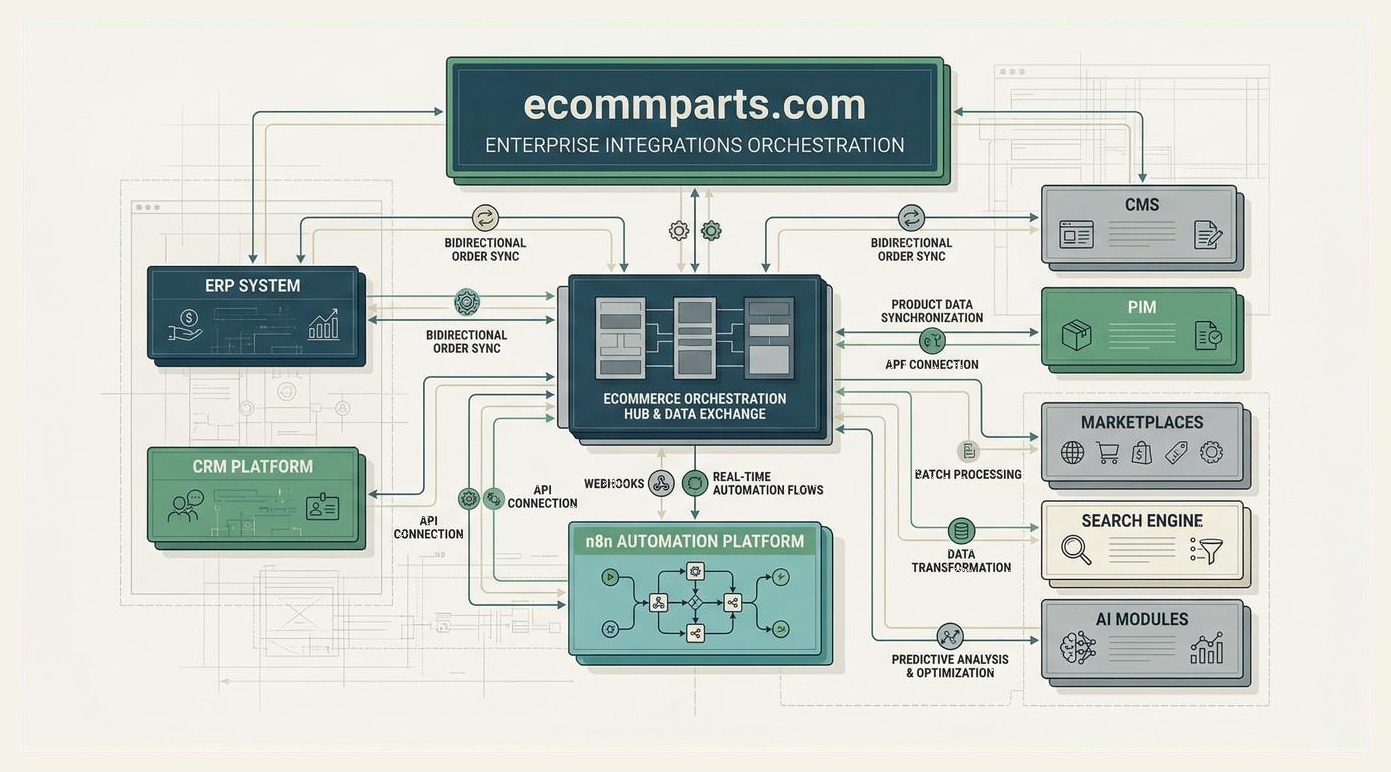
The ecommparts architecture is designed to coordinate bidirectional flows between catalog, customers, orders, compatibility rules, technical content and commercial signals. This enables moving from reactive integrations to maintainable, business-oriented orchestration.
Ecommparts centralizes references, attributes, equivalences, models, compatibility matrices and business rules so the catalog stops being a source of friction and becomes a conversion engine.
The platform introduces an AI layer for matching suggestions, semantic enrichment, data normalization and content preparation for search engines and assistants.
ERP, CMS, CRM, PIM, marketplaces, internal search engine and proprietary modules can work on a coordinated architecture, designed for technical commerce and complex catalogs.
AI in ecommparts is not decoration. It integrates into the catalog workflow to detect relationships, improve attributes, suggest correspondences, strengthen technical searches and help structure more useful content for buyers and assistants.

Organic visibility no longer depends solely on indexing product pages. A structure is needed that can organize entities, answer questions, distribute context and build topical authority in an environment where traditional search engines, contextual search and generative assistants coexist.
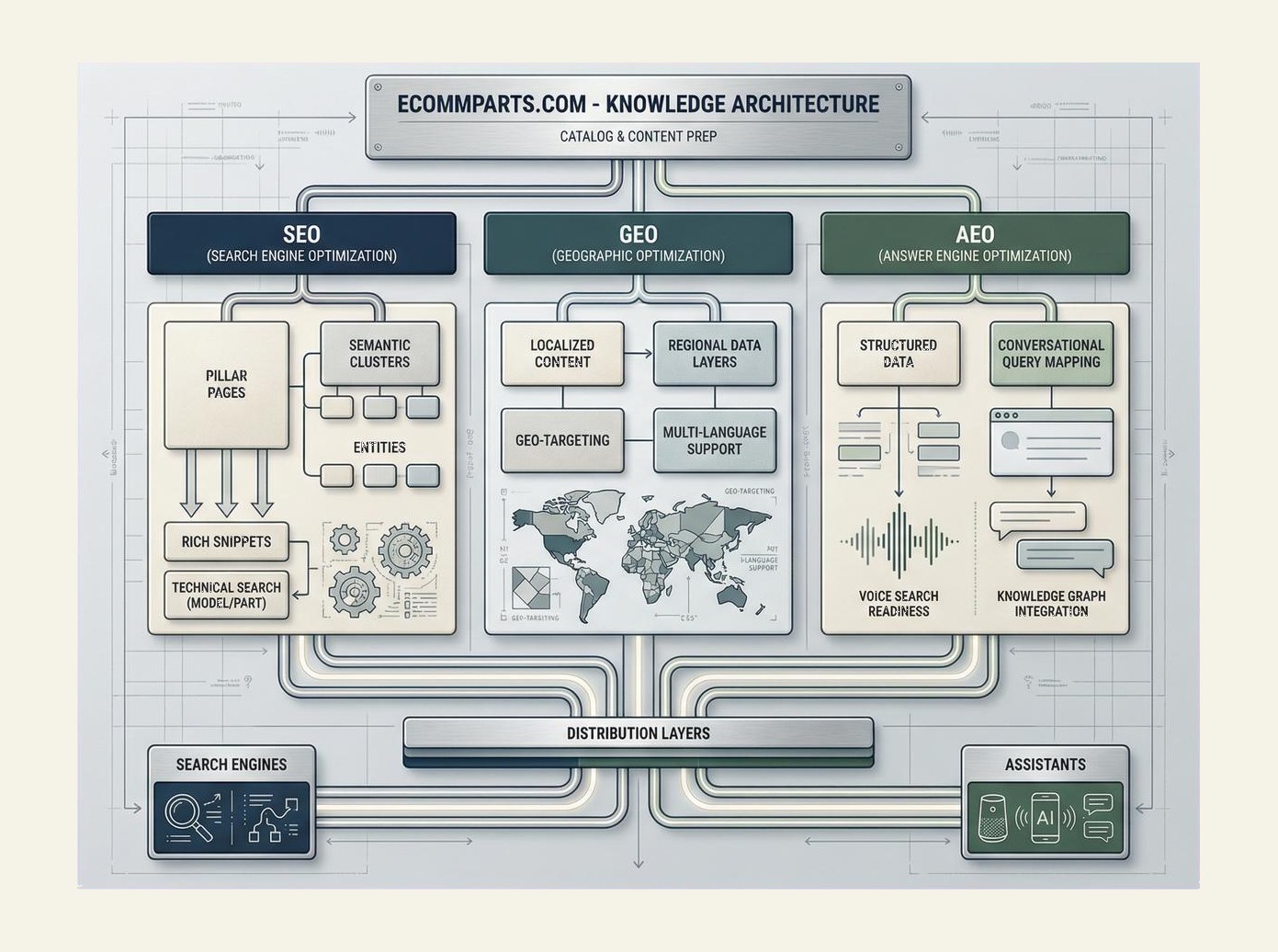
Pillar pages, clusters, entities, internal links, rich results and clean architecture for searches by part, model, machine or technical category.
Preparation for markets, languages, verticals and relevant geographic signals when the catalog needs local and sector-specific context.
Content prepared for assistants, conversational answers, structured data and informational blocks ready to be interpreted by generative systems.
The platform is built for environments where compatibilities, attributes, cross-references and product logic directly affect conversion, support and operational efficiency.
Catalog architecture, integration and visibility tailored to operations with a high level of technical complexity.
Catalog architecture, integration and visibility tailored to operations with a high level of technical complexity.
Catalog architecture, integration and visibility tailored to operations with a high level of technical complexity.
Catalog architecture, integration and visibility tailored to operations with a high level of technical complexity.
Catalog architecture, integration and visibility tailored to operations with a high level of technical complexity.
Catalog architecture, integration and visibility tailored to operations with a high level of technical complexity.
This content layer does not only help convert. It also improves the semantic interpretation of the site and makes it easier for the brand to respond better in conversational search contexts.
The difference lies in the orchestration layer. Ecommparts does not just organize compatibilities; it connects ERP, CMS, CRM, n8n automations, applied AI and visibility architecture to turn the catalog into an operational and commercial advantage.
That is precisely the approach. The platform is designed as a connection and data governance infrastructure, built to synchronize existing systems and reduce silos without requiring a complete reimplementation.
AI enables attribute enrichment, correspondence suggestions, inconsistency detection, contextual search reinforcement and preparation of more useful content for users and answer engines.
SEO improves visibility in traditional search engines; GEO helps structure relevance by market, language and context; AEO prepares content for assistants and engines that directly answer user questions.
Ecommparts is designed for brands and distributors that need more than vertical software: they need an infrastructure that connects data, processes, integrations and visibility.